
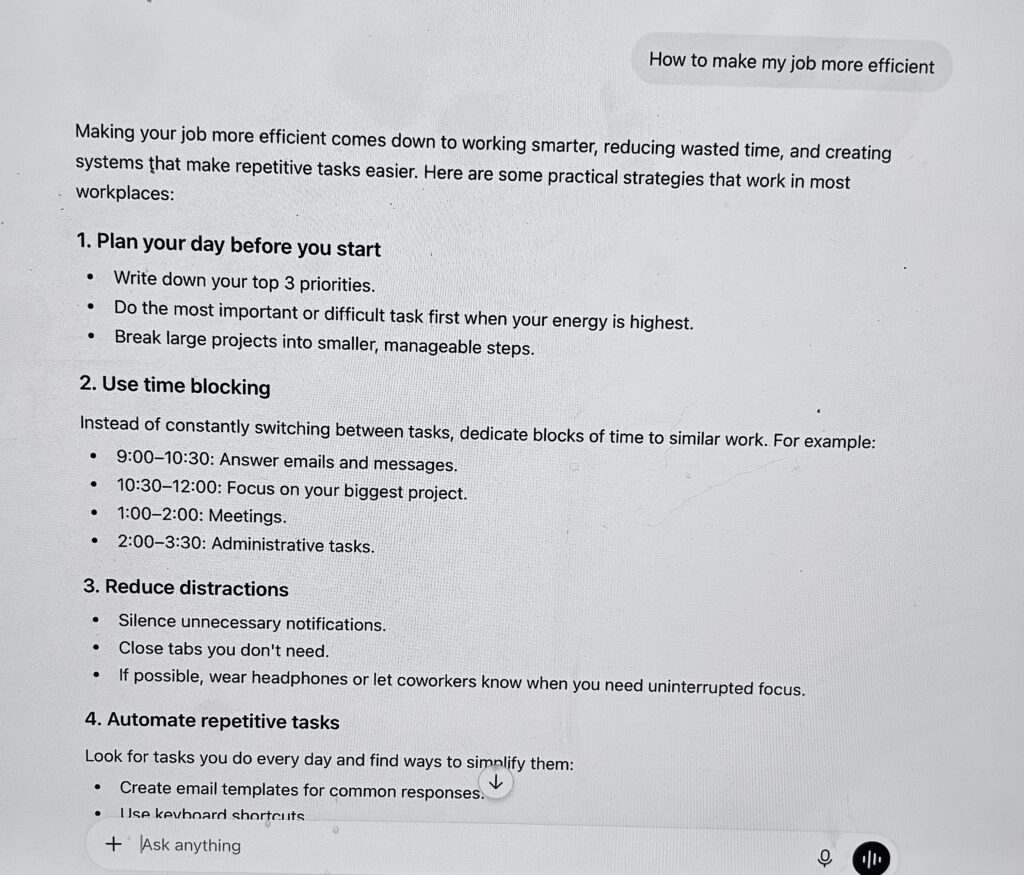
AI offering ideas to make the workplace more efficient (Kelly, 2026).
There is growing concern about human jobs as artificial intelligence (AI) becomes more common in the workplace. Employees and employers, in Canada, are concerned about AI taking over the workplace. However, based on current workforce trends from 2025-2026, it appears that AI is being used to transform jobs, through automation and collaboration tools, instead of replacing them altogether.
AI experts believe that AI is likely to be used in collaboration with human employees, instead of replacing them altogether (MIT Sloan Office of Communications, 2025). While some jobs may change with AI, there are things offered by human interactions, and connections, that AI cannot replicate.
What are the Benefits of AI in the Workplace?

AI helping to streamline data management (Kelly, 2026).
AI has been growing quickly in the workforce. It can perform tasks at an alarmingly rapid pace. This rapid pace can benefit a company by:
- Increasing productivity – AI has the ability to perform certain tasks at a faster pace than humans. It can look through data and identify trends much faster than it would take a human. It can also relieve humans of the mundane tasks which allows them to focus on other things.
- Improve customer service – AI offers chatbots that many companies have utilized. These chatbots offer 24-hour customer service where customers can ask questions, or get advice and/or direction with issues.
- Risk Management/Security – AI can predict possible risks and identify fraudulent patterns faster than a human may be able to predict/identify it. This can save companies from serious financial or security issues.
Which Jobs Are Most Likely to be Exposed to AI?
Jobs that have the potential to be “highly exposed to AI-related job transformation are generally those that require higher education” (Statistics Canada, 2026).

Human input remains essential when using AI in the workplace (Kelly, 2026).
There are jobs that are estimated to get high exposure to AI with high complementarity, while others are expected to get high exposure and low complementarity. Let’s take a look at some of the high exposure jobs below.
High-Exposure/High-Complementarity
- General practitioners and family physicians
- Secondary school teachers
- Electrical engineers
High-Exposure/Low-Complementarity
- Economists
- Computer network technicians
- Data entry clerks
- Computer programmers and interactive media developers
Other Jobs at High Risk of Transformation
- Office support occupations
- Service supervisors and specialized service occupations
- Industrial and construction trades
- Sales representative and other customer and personal services occupations
- Maintenance and equipment operation trades
- Administrative and financial supervisors and administrative occupations
Lists curated from information on Statistics Canada (2020) and (2024).
Are These Jobs at Risk of Being Replaced By AI?

Taking a traditional approach by organizing information manually instead of the use of technology (Kelly, 2026).
The short answer is no. There are things done by humans that just can’t be replicated quite the same by AI. AI doesn’t have the emotional intelligence, physical capabilities, judgement and ethics that are displayed by humans in the workforce.
Instead, “people have a greater appetite for using the technology as a collaborative tool to assist humans, rather than a replacement for them” (Jette, 2026, para. 10).
From November 2022 to December 2025, “employment generally grew regardless of potential occupational exposure to and complementarity with artificial intelligence” (Statistics Canada, 2026, para. 17).
Recent research is showing that CEOs are finding that AI is not fulfilling its role in the workforce. At times, it is found to decrease productivity as employees are needing to review the work being produced by AI. (Rana, 2026).

An organized desk reflects how AI is becoming an important tool in today’s workplace (Kelly, 2026).
So, should you really be concerned about AI taking over your job? Based off the workforce trends from 2025-2026, no. If AI is being introduced into your workplace, it is likely that it is being introduced to work in collaboration with your position rather than replacing it altogether. Consider it your cheeky work sidekick that tackles the mundane tasks that you do not want to be doing anyways!
Please join me in listening to an interview with Paula Higgins, a local actress and theatre production director, who has had AI implemented into her work. She talks about her experiences, good and bad, throughout this implementation.
References
Tusic99 (2024). Mystical melodic gling, computer music box [Song]. On Solo Instrument [Album]. Freesound.
“mystical melodic gling, computer music box” by tusic99 is marked with CC0 1.0.
Watch my follow-up video interview with Paula Higgins three months after our audio interview.
References in Interview Video
Higgins, P. [_paulahiggins]. (2025, September 15). 525 600 minutes in a year and only 7650 minutes until rent closes! Set and Costume by Starlynn Chen | Lighting Design … [Photo]. Instagram. https://www.instagram.com/p/DOo5B_Jkuk-/
Higgins, P. [_paulahiggins]. (2025, May 14). Hi my name is Paula Higgins, I’m 5’9 and I’m based in Vancouver, BC 📸: @shimonphoto [Photo]. Instagram. https://www.instagram.com/p/DJqXmgERGXT/
Higgins, P. [_paulahiggins]. (2024, March 27). Happy World Theatre Day! I feel so lucky to have been able to do so much theatre this past year… [Video]. Instagram. https://www.instagram.com/reel/C5COJ2dPJce/
Kelly, A. (2026, July 2). AI helping to streamline data management [Photo]. Trubox. https://ainsleykelly.trubox.ca/informative-story/
Lee, W. (2026, July 6). AI actor Tilly Norwood to star in first movie – Los Angeles Times. Los Angeles Times. https://www.latimes.com/entertainment-arts/business/story/2026-07-06/ai-actor-tilly-norwood-movie-hollywood-ai
Lee, W. (2025, October 2). Fake actor deepens anxiety over AI in Hollywood – Los Angeles Times. Los Angeles Times. https://www.latimes.com/entertainment-arts/business/story/2025-10-02/why-hollywood-actors-are-outraged-at-ai-character-tilly-norwood
Radio One International. (2025, February 10). “Oscars introduce mandatory AI disclosure rule | Hollywood’s big tech shift!”[Video]. YouTube. https://www.youtube.com/watch?v=6YZtBJM2CrY
Richwine, L. and Chmielewski, D. (2023, June 28). From caterers to cowboy outfitters: Writer’s strike hits Hollywood economy. Reuters. https://www.reuters.com/world/us/caterers-cowboy-outfitters-writers-strike-hits-hollywood-economy-2023-06-28/
Semley, J. (2026, June 24). A24 knows you’re mad about the Google AI collab. WIRED. https://www.wired.com/story/a24-knows-youre-mad-about-the-google-ai-collab/